
How to choose an electric radiator
An electric radiator plugs into a socket (or is wired into a spur) and turns electricity straight into heat, with no boiler, pipes or flue. They are the simple answer for a home without gas, a cold room the central heating never reaches, a garden office or a conservatory. Choose one by the size of the room, how you want to control it and where it will go, and know what it will cost before you buy.
What an electric radiator costs to run
Cost per hour = power in kW x price per kWh. At today's UK average of 26.32p per kWh:
| Power | Per hour at full power | 4 hours a day at half power, for a month |
|---|---|---|
| 500W | 13.2p | £7.90 |
| 1kW | 26.3p | £15.79 |
| 1.5kW | 39.5p | £23.69 |
| 2kW | 52.6p | £31.58 |
| 2.5kW | 65.8p | £39.48 |
| 3kW | 79.0p | £47.38 |
The figure that matters is how many kWh the heater uses, and that comes from its wattage and how long it is on. A thermostat cuts the power once the room is warm, so a radiator sized for the room spends much of its time off. The running cost calculator does the sums for your hours and your region, and every product on this site shows its own cost per hour.
What size: watts for the room
| Room | Usual size |
|---|---|
| Bathroom, small bedroom, home office (up to 15 cubic metres) | 500W to 1kW |
| Double bedroom, kitchen (15 to 35 cubic metres) | 1kW to 1.5kW |
| Living room (35 to 50 cubic metres) | 2kW, or two smaller radiators |
| Large lounge, open plan, conservatory | 2.5kW or more, often split across two |
Undersized heaters cost more to live with: they run at full power for hours and never quite get there. Two smaller radiators on opposite walls heat a big room more evenly than one large one. Use the size calculator for your room.
Which type: oil filled, oil free, panel or infrared
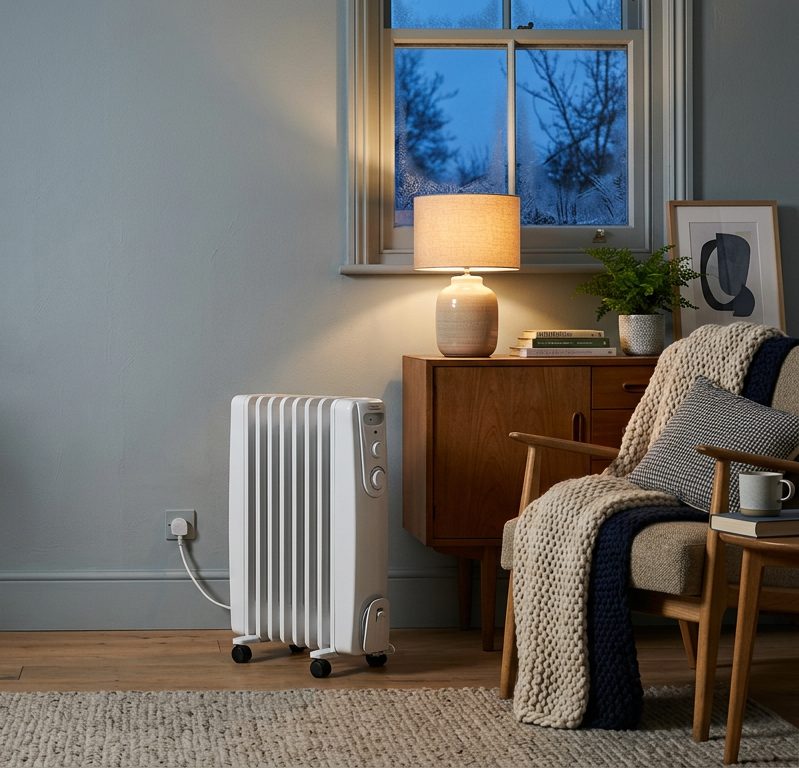
- Oil filled radiators heat a sealed reservoir of oil that keeps giving off heat after the element switches off. Gentle, even and silent. Most are freestanding on wheels; some are wall mounted.
- Oil free (dry thermal) radiators use an aluminium or ceramic core instead of oil. They warm up faster and are lighter, and are what most wall mounted electric radiators use.
- Panel heaters are slim convectors that warm the air quickly. Cheap to buy and good in rooms you heat for short spells.
- Infrared panels warm people, walls and furniture directly rather than the air, a bit like sunshine. They suit draughty rooms, high ceilings and offices, and can hang flat on a wall or ceiling.
Thermostats, timers and WiFi
Controls make the biggest difference to running costs. A digital thermostat holds the room at the temperature you choose instead of cycling on a rough dial. A 7-day timer means the heater is on only when you need it. Smart radiators add an app, so you can turn the heat on before you get home and see how much energy each one used. Features such as an open window sensor and an eco setback mode trim waste further. On a cheap heater, look for an electronic thermostat with a temperature display rather than a plain dial marked 1 to 6.
Bathrooms
An electric towel rail dries towels and takes the chill off a bathroom for very little: a 100W to 300W rail costs pennies an hour. Anything fixed in a bathroom must be rated for its zone (look for IPX4 or better) and wired in by an electrician. Never use a plug-in heater in a bathroom unless it is made for one.
Safety
Plug heaters straight into a wall socket, not an extension lead: a 2kW to 3kW heater draws close to what a lead can carry. Keep 1m clear in front, never cover a heater or dry clothes on one unless it is made for it, and choose one with overheat protection and a tip-over switch if it is freestanding.
Frequently asked questions
How much does an electric radiator cost to run per hour?
Its kW multiplied by the price per kWh. Today that is 26.3p an hour for 1kW and 52.6p for 2kW at full power. With a thermostat a radiator usually averages half that or less once the room is warm.
Are oil filled radiators cheaper to run?
Not per unit of heat: every electric heater turns 1kWh into 1kWh of heat. Oil filled radiators store heat, so they feel more even and cycle less sharply, but 2kW costs the same per hour whatever the type.
What is the cheapest electric heater to run?
The one with the lowest wattage that still heats your space, controlled by a thermostat and timer. A low-wattage heater costs little per hour but may not warm a large room. See the cheapest to run list, or sort any collection by "Cheapest to run".
Can I leave an oil filled radiator on overnight?
Modern oil filled radiators with a thermostat and overheat cut-off are made to run unattended, and many people use them on a low setting overnight. Keep it clear of bedding and curtains, plug it straight into the wall and use the timer so it isn't on longer than you need.
Is an electric radiator cheaper than gas central heating?
Per kWh of heat, no: electricity costs roughly four times as much as gas. Electric radiators win where there is no gas, for one room you use a lot, or as a top-up so the whole house thermostat can stay lower.